

Furuno becomes the first company in Japan to receive live signals transmitted from Xona's Pulsar LEO PNT satellite

Xona | Furuno
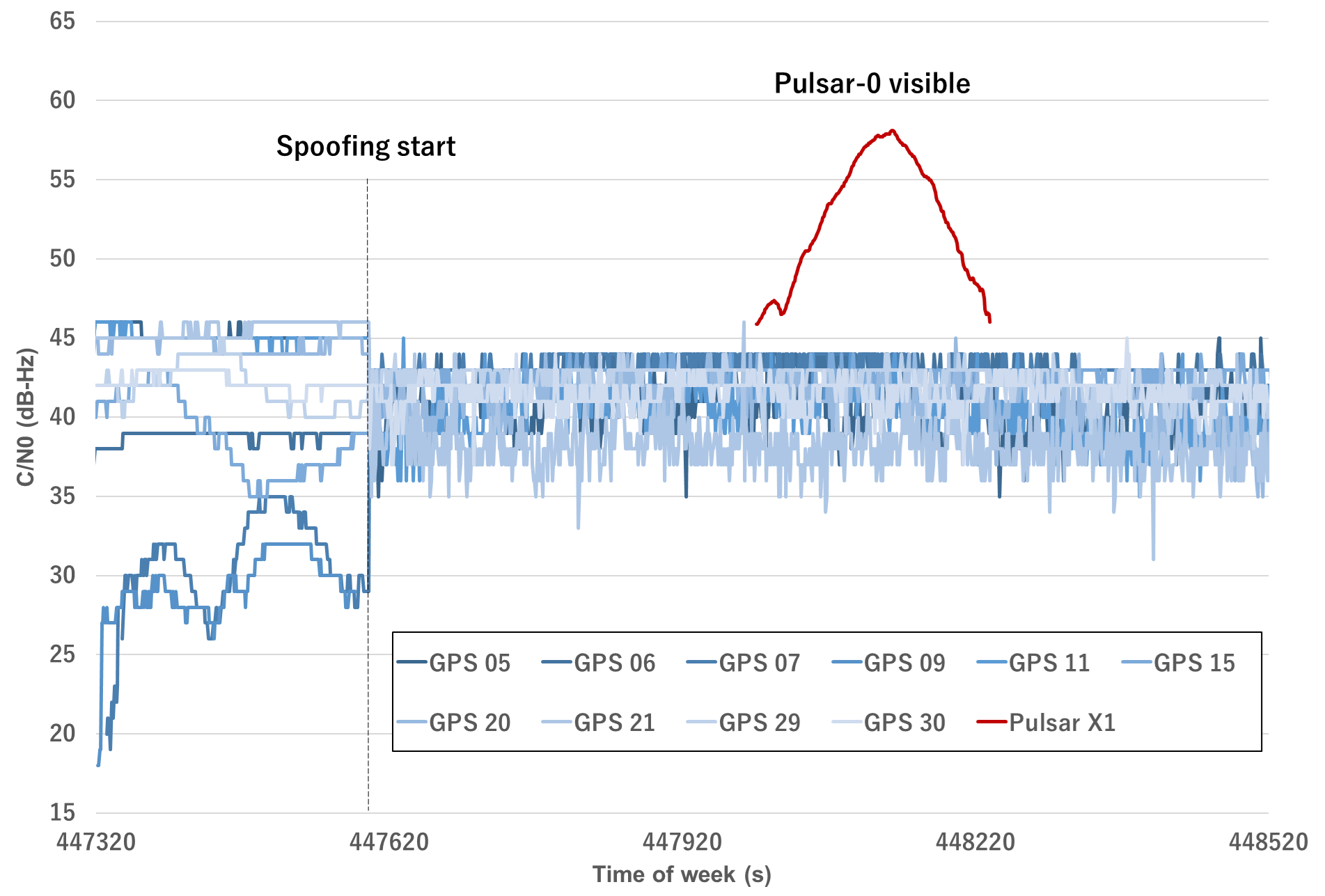
Pulsar-0 tracked while GPS actively being spoofed
NISHINOMIYA, HYOGO, JAPAN, August 4, 2026 /EINPresswire.com/ -- "We are pleased to announce that Furuno successfully received live signals in Nishinomiya, Japan, in June 2026 from Pulsar-0, the first satellite in the next-generation low Earth orbit (LEO) satellite-based positioning service developed by Xona Space Systems, Inc. (hereinafter "Xona"). This marks the first reception of live Pulsar satellite signals in Japan. *¹ "
In July 2026, Furuno also confirmed at a GNSS spoofing test *² conducted at the Fukushima Robot Test Field that live Pulsar satellite signals could be received reliably using the same antenna as GNSS, remaining stable even when spoofing signals disrupted traditional global navigation satellite systems (GNSS).
With additional Pulsar satellites set for launch this year, these results represent a foundational reception evaluation toward the practical use of positioning and timing sources independent of GNSS and mark a step toward reducing critical infrastructure's overreliance on GNSS and strengthening PNT *³ resilience.
The vertical axis of the graph represents C/N0, which indicates signal strength. The GNSS signals are concentrated around 40 dB-Hz because the receiver is tracking the spoofing signals, causing all satellite signals to be observed at a similar signal strength.
Background
In recent years, critical infrastructure and communications systems have become increasingly dependent on GNSS, including GPS, while risks such as jamming, spoofing, and service disruptions have grown more apparent. For critical infrastructure that relies heavily on precise GNSS-based time synchronization, including mobile communications, broadcasting, financial transactions, power grid control, and public safety radio, securing an alternative means of maintaining operations without interruption during a GNSS outage has become an urgent priority.
As a GNSS receiver manufacturer, Furuno has developed receiver-level countermeasures such as dual-frequency reception, signal authentication, and holdover. This initiative adds a system-level countermeasure by incorporating LEO PNT, a positioning technology that uses low Earth orbit satellites to provide a positioning and timing source independent of GNSS.
In February 2026, Furuno and Xona signed a memorandum of understanding (MoU) to develop LEO PNT solutions. This reception evaluation marks a milestone in advancing the collaboration from concept to proof of feasibility.
Evaluation results
The evaluation used a commercially available GNSS antenna and an evaluation unit based on a commercial GNSS receiver, with only limited firmware modifications. The spoofing signals used in this test targeted GNSS and did not specifically target the Pulsar signal.
Because Pulsar signals are transmitted in the L-band near GNSS frequencies, Furuno was able to receive them using existing GNSS antenna and hardware technologies with only minor firmware modifications, without developing large-scale dedicated equipment.
The results demonstrate that Furuno can rapidly apply its existing technology assets to Pulsar signal reception. They also indicate the potential to use Pulsar for more secure positioning and time synchronization while maintaining compatibility with GNSS.
Significance of the results
Even when GNSS is affected by jamming, disruption, or spoofing, LEO PNT can serve as an alternative or complementary source for positioning and time synchronization, significantly contributing to the operational continuity of critical infrastructure. As a first step toward this goal, the evaluation confirmed the reception of live Pulsar satellite signals in both a normal environment in Japan and a GNSS spoofing test environment.
Furuno will continue advancing the use of LEO PNT as a promising technology for reducing critical infrastructure's overreliance on GNSS. Through positioning and time synchronization solutions with high resilience and security, Furuno aims to contribute to the continued development of critical infrastructure.
About Xona Space Systems, Inc.
Xona is the navigational infrastructure company bringing centimeter-level certainty to any device, anywhere on Earth.
With Pulsar, the most advanced positioning, navigation, and timing (PNT) constellation in Low Earth Orbit, Xona will enable absolute precision, built-in protection against jamming and spoofing, and superior power to the billions of devices that rely on GPS today. Learn more at www.xonaspace.com or connect with us via LinkedIn, or X @XonaSpace.
*1 Based on Furuno's own review of publicly available information.
*2 The GNSS spoofing test was conducted as part of the 7th Spoofing Field Test organized by the Jamming/Spoofing Study Group of the Institute of Positioning, Navigation and Timing of Japan. The test was supported by LocationMind Inc., the Japan Aerospace Exploration Agency (JAXA), AmTechs Corporation, SoftBank Corp., Osaka Metropolitan University, and Tokyo University of Marine Science and Technology. For the test equipment, AmTechs Corporation provided the GSS7000 and Standpoint from Spirent Communications plc, now Keysight Technologies, under academic terms.
*3 Positioning, Navigation, and Timing
Related link
Announced on February 3, 2026: Furuno and Xona Space Systems sign MoU to develop innovative LEO PNT solutions
https://www.furuno.co.jp/en/news/general/general_category.html?itemid=1773&dispmid=961
Marketing Section
System Products Division
+81 798-33-7517
email us here
Legal Disclaimer:
EIN Presswire provides this news content "as is" without warranty of any kind. We do not accept any responsibility or liability for the accuracy, content, images, videos, licenses, completeness, legality, or reliability of the information contained in this article. If you have any complaints or copyright issues related to this article, kindly contact the author above.
